



Imagine watching your child struggle to join in at school while you’re caught between a teacher’s concerns and a relative’s insistence that they’ll simply grow out of it. This uncertainty is heavy, but seeking a child behavioural assessment Malaysia shouldn’t be a frightening step. It’s a way to replace confusion with clarity. You’ve likely felt the anxiety of conflicting advice or the worry that your child isn’t meeting their full potential in the classroom.
It’s natural to worry that clinical tests feel cold or that a diagnosis might limit your child’s future. We believe an assessment is a supportive roadmap for potential, not a clinical label for limitation. This guide shows how professional insights provide a clear path to support your child’s unique developmental journey in Malaysia, offering you the peace of mind that comes from understanding their specific needs.
We’ll explore the assessment process, from play-based evaluations to actionable strategies for home and school. You’ll gain a clear understanding of how to support your child’s growth and bridge the gap between their current struggles and their future success.
Key Takeaways
- Understand how a professional evaluation identifies your child’s unique strengths and specific areas for growth rather than focusing solely on challenges.
- Learn why a multidisciplinary team is essential for a comprehensive child behavioural assessment Malaysia to ensure all developmental needs are accurately identified.
- Discover what to expect during the clinical journey, from the initial intake of developmental history to gentle, play-based interaction sessions.
- See how a detailed assessment report transforms into a practical action plan for school accommodations and targeted support like speech or occupational therapy.
What is a Child Behavioural Assessment and Why is it Essential?
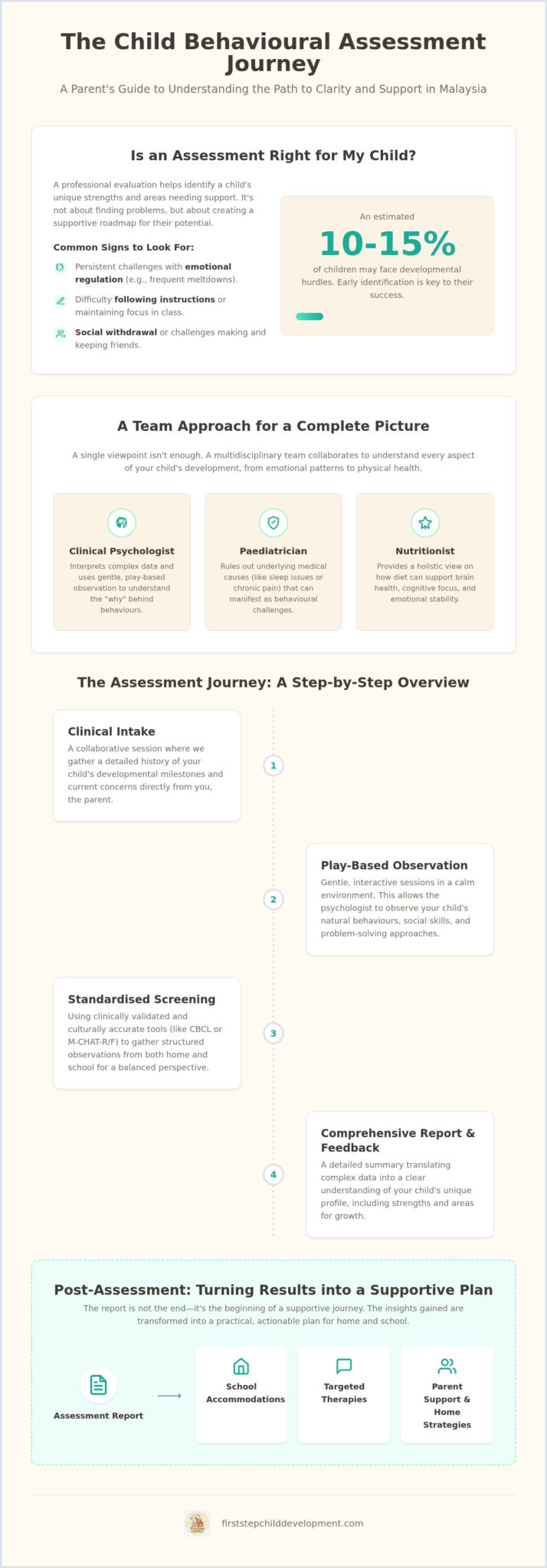
A child behavioural assessment Malaysia is a professional evaluation designed to understand your child’s emotional, social, and cognitive development. Rather than focusing only on “problems,” this process identifies a child’s unique strengths alongside the areas where they require extra support. It’s a way to see the whole child. In our local context, these assessments are vital for measuring school readiness and social integration. With data suggesting that roughly 10% to 15% of children may face developmental hurdles, early identification is key. It ensures that challenges don’t become barriers to their long-term well-being or academic success in the Malaysian school system.
Common Signs That May Warrant a Professional Evaluation
When considering a child behavioural assessment Malaysia, parents often notice subtle signs before they become major obstacles. You might observe persistent challenges with emotional regulation, such as frequent meltdowns that seem out of proportion to the situation. In a classroom, a child might have trouble following instructions or maintaining focus. Social withdrawal or difficulty making friends can also indicate a need for deeper exploration. Professionals often use the Child Behavior Checklist (CBCL) to gather structured observations from home and school, providing a balanced perspective.
The Difference Between Behavioural and Neurodevelopmental Assessments
While people often use these terms interchangeably, they serve different purposes. A behavioural assessment focuses on emotional patterns, whereas neurodevelopmental evaluations look for conditions like ADHD or Autism. A comprehensive approach often combines both for the clearest picture. It’s about finding a roadmap, not a label. Booking Clinical Psychologist Consultations is the first step to determine the right path, ensuring your child receives support tailored to their unique journey.
The Multidisciplinary Approach: Why Clinical Expertise Matters
A child’s developmental journey is rarely a straight line; understanding it requires looking through multiple lenses. A team approach ensures that a child behavioural assessment Malaysia provides a complete picture rather than a single clinical snapshot. By combining the expertise of psychologists, paediatricians, and nutritionists, we can differentiate between a developmental delay and a physical health concern. For instance, a child who seems inattentive might actually be struggling with a hearing issue or nutritional deficiencies that impact cognitive focus. For a broader perspective on local support, you can explore our Child Psychology in Malaysia: 2026 Parent’s Guide. Experts often use gold-standard tools like the M-CHAT-R/F, which have been specifically validated in the Malay language to ensure cultural accuracy.
The Role of the Clinical Psychologist
Clinical psychologists are the specialists who interpret complex psychometric data and translate it into a supportive roadmap for parents. They use standardised Developmental and Behavioral Screening Tests to ensure clinical accuracy. However, the true value lies in clinical observation within a gentle, play-based environment. This approach allows the psychologist to see how your child interacts naturally, providing insights that a test score alone cannot capture. It’s about understanding the “why” behind the behaviour.
Integrating Paediatric and Nutritional Insights
Physical health is the foundation of all behaviour. Paediatricians play a vital role by ruling out medical causes, such as sleep apnea or chronic pain, that might manifest as irritability or defiance. Similarly, Nutritionist Consultations offer a holistic view of how diet supports brain health and emotional stability. This multidisciplinary care ensures that every aspect of your child’s well-being is considered. If you’re ready to gain this professional clarity, speaking with our team is a helpful next step.
The Assessment Journey: What to Expect from Start to Finish
Embarking on a child behavioural assessment Malaysia is a collaborative process that moves at your child’s pace. It begins with a clinical intake, where we gather a detailed history of milestones and current concerns directly from you. This is followed by the assessment session, featuring direct interaction between your child and our specialists. We also include a period of observation in a gentle clinical setting to see how they naturally engage with their surroundings. The journey concludes with a feedback session, where we review the results together and create a personalised support plan that bridges the gap between home and school life.
Preparing Your Child for the Assessment Visit
A little preparation goes a long way in reducing “new place” jitters. We recommend telling your child they are going to “play with a teacher” or “visit a specialist who helps kids learn.” It’s best to avoid clinical language that might sound intimidating. On the day, ensure they’ve had a healthy meal and a good night’s sleep so they can engage comfortably. Our centres are designed to be nurturing spaces, not clinical offices, ensuring your child feels safe and understood from the moment they walk in.
Standardised Testing and Play-Based Observations
What looks like play is actually a sophisticated gathering of data. Most tasks involve puzzles, drawing, or storytelling games that children find engaging. By using Clinical Psychologist Assessments, we collect objective data while maintaining a relaxed atmosphere. This dual approach of standardised testing and play-based observation ensures the results are accurate and reflective of your child’s daily life. If you’re ready to gain this professional clarity, explore how our assessments work to find the best path forward for your family.
Post-Assessment: Turning Results into a Supportive Plan
Receiving the final report of a child behavioural assessment Malaysia is a pivotal moment for any family. This document serves as much more than a summary; it’s a formal tool you can use to request essential school accommodations. In many Malaysian international and private schools across Kuala Lumpur and Selangor, a professional report allows teachers to implement tailored learning strategies or environmental adjustments. The journey doesn’t end with the assessment. It’s the beginning of a collaborative effort to help your child reach their full potential. The feedback session is perhaps the most vital part of this process. It’s a dedicated time for you to ask questions, clarify goals, and ensure you feel confident in the next steps. We focus on providing a clear roadmap that replaces worry with actionable hope.
Linking Assessment to Targeted Therapies
The assessment results often highlight specific areas where targeted support can make a significant difference. For children experiencing communication-related hurdles, the psychologist may recommend Speech Therapy to build social and verbal skills. If the assessment identifies sensory processing difficulties or coordination struggles, Pediatric Occupational Therapy can provide practical strategies to help your child manage their environment more effectively. These therapies aren’t just about addressing challenges; they’re about empowering your child with the tools they need to thrive in daily life.
Ongoing Guidance for Parents and Schools
Managing behaviours at home requires a consistent and empathetic approach. Our clinical psychologists provide parents with actionable strategies to handle daily challenges, ensuring that the support your child receives is holistic. We also advocate for regular multidisciplinary reviews. These follow-up sessions allow the team to track your child’s progress, celebrate milestones, and adjust therapy goals as they grow. This steady, paced approach ensures your family is never alone in this journey. By working together, we can ensure the strategies used at school are mirrored at home, creating a stable environment for your child’s development.
Supporting Your Child’s Unique Journey
Navigating your child’s developmental milestones can feel overwhelming, but you don’t have to do it alone. A child behavioural assessment Malaysia is a transformative step that replaces uncertainty with a clear, professional roadmap. By choosing a multidisciplinary team in Kuala Lumpur and Selangor, you ensure that every aspect of your child’s growth is considered, from psychological well-being to nutritional health. Our gentle, play-based diagnostic environment is designed to help your child feel safe while we gather the insights needed to unlock their potential.
The detailed feedback and actionable reports you receive are practical tools that bridge the gap between home and school life. These resources empower you to advocate for your child’s needs and implement strategies that foster long-term confidence. If you have concerns about your child’s development, learn more about our professional assessments or visit our homepage to connect with our team. Your child has unique strengths waiting to be discovered, and we’re here to help you guide them toward a bright future.
Frequently Asked Questions
How much does a child behavioural assessment cost in Malaysia?
Costs for evaluations vary significantly across the private and public sectors. While government facilities are highly subsidised, they often involve extensive waiting lists that can delay early intervention. Private centres offer faster access to specialists but involve professional fees for testing and feedback. At Firststep, we provide fixed-price diagnostic packages to ensure financial clarity for families in Kuala Lumpur and Selangor, helping you plan your child’s developmental support without unexpected costs.
How long does a full psychological assessment take for a child?
A full psychological assessment is a methodical process that typically spans several hours or multiple sessions. The direct interaction phase usually takes between two and four hours. This ensures the specialist gathers sufficient data without exhausting the child. At our centres in Petaling Jaya and KL, we prioritise a gentle pace. This allows for clinical intake, play-based observation, and standardised testing to be completed thoroughly while maintaining your child’s comfort throughout.
Will my child be “labelled” for life after a behavioural assessment?
An assessment is a roadmap to support, not a permanent label that limits your child’s future. The primary goal of a child behavioural assessment Malaysia is to identify specific strengths and areas for growth. This professional clarity allows schools and therapists to provide targeted intervention. A diagnosis or explanation serves as a key to unlock resources and accommodations, ensuring your child receives the right support to reach their full potential at home and school.
What is the difference between a school counsellor and a clinical psychologist?
While both professionals support well-being, their roles differ in scope and clinical depth. School counsellors focus on immediate academic or social issues within the educational environment. In contrast, clinical psychologists possess advanced training to conduct in-depth diagnostic assessments and interpret complex psychometric data. They provide a comprehensive view of neurodevelopmental and emotional needs, offering specialised support plans that go beyond the classroom to address your child’s holistic development and long-term mental health.
At what age should I consider a behavioural assessment for my child?
You should consider an assessment as soon as you notice persistent developmental or social concerns. Early intervention is most effective when started young, often between the ages of two and six. In Malaysia, routine screenings often stop after the 18-month vaccination visit. If your child struggles with emotional regulation or social milestones in preschool, seeking professional guidance early provides the best foundation for their success as they transition into primary school.

Article by
Firststep Child Development Team
Firststep Child Development Team provides evidence-informed educational resources to help parents better understand child development, behaviour and learning. Our multidisciplinary services include clinical psychology, occupational therapy, speech and language therapy, developmental assessments and other child development support in Kuala Lumpur and Selangor.
Disclaimer
This article is for general educational and informational purposes only and is not a substitute for professional medical, psychological or therapeutic advice, diagnosis or treatment. Every child develops differently. If you have concerns about your child's development, behaviour, learning or wellbeing, please consult an appropriately qualified healthcare or allied health professional.