



A child’s confidence can grow even when learning feels difficult. Building self-esteem in a child with learning disabilities starts with noticing their strengths, recognising effort and progress, and offering chances to make choices and succeed in activities that matter to them. Small, sincere moments of encouragement can help a child feel valued without suggesting that every task will be easy.
It’s understandable to worry when a child avoids challenges, feels discouraged by mistakes or compares themselves with classmates. Building self-esteem in a child with learning disabilities starts with helping them feel safe talking about these experiences while finding practical ways to grow their independence and confidence.
Choose confidence-building activities, give specific praise, celebrate achievements and help your child recognise their individual strengths. Parents and teachers can also set realistic goals and work together so encouragement feels consistent at home and at school.
Key Takeaways
- Offer activities that match your child’s interests and let them choose between a few options to build a sense of control.
- Notice and praise specific effort, progress and small achievements, not only completed tasks or results.
- Identify your child’s strengths and use them to set realistic goals without comparing them with siblings or classmates.
- Pay attention to signs of discouragement or withdrawal, and talk with your child and their teacher about supportive next steps.
1. Using extracurricular activities to support self-esteem
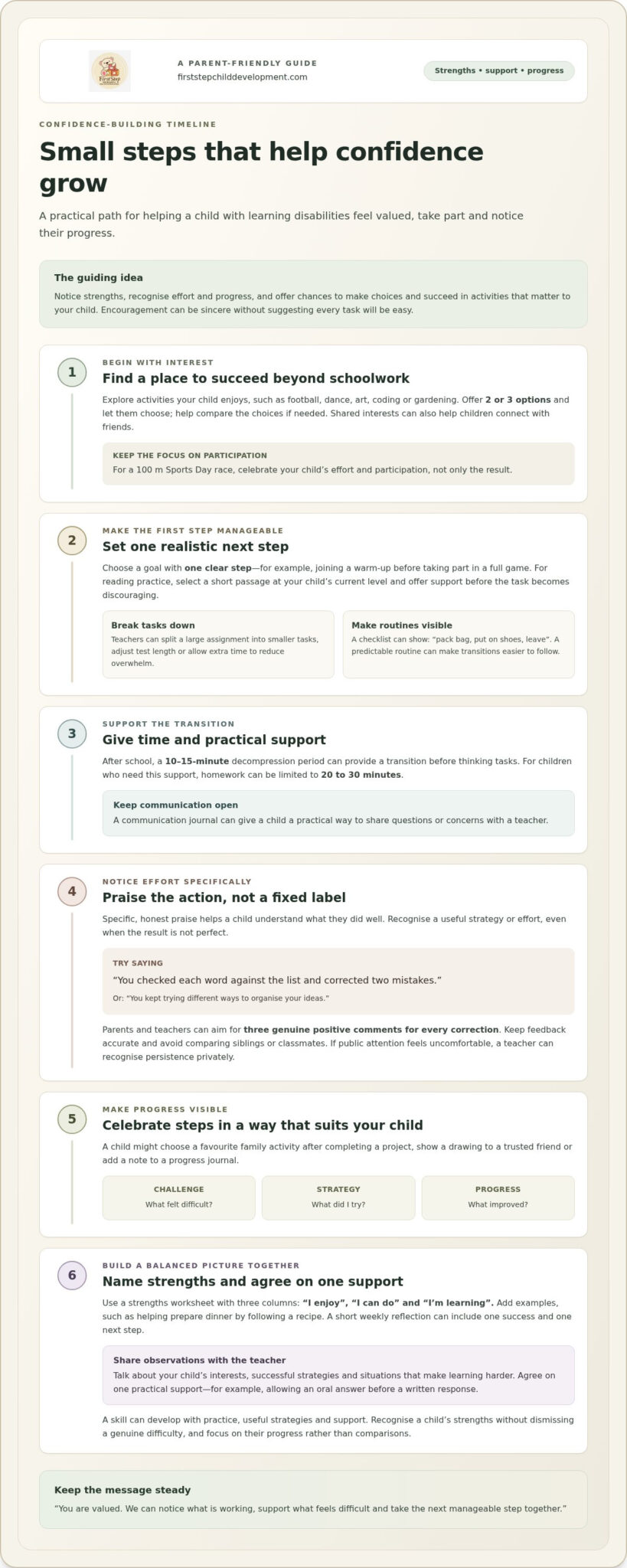
An extracurricular activity gives a child a chance to succeed beyond reading or written schoolwork. Children who feel unsure in class may avoid group tasks, yet enjoy football, dance, art, coding or gardening. Start with an interest-led activity where progress is visible. If your child completes a 100 m Sports Day race, celebrate their effort and participation, not only the result. Shared interests can also help them connect with friends.
Offer your child 2 or 3 activity options, then let them choose. Making a decision supports a sense of control, even if they need help comparing choices. At school, teachers can invite pupils to create class rules, guidelines and consequences together. A classroom job, such as handing out art materials, gives a child a clear role in the group. Cooperative games also let classmates practise problem-solving and support one another.
Set a realistic goal with one clear step, such as joining a warm-up before taking part in a full game. For reading practice, choose a short passage at your child’s current level and offer support before difficulty becomes discouraging. This low-pressure approach, sometimes called errorless learning, makes success easier to experience while your child builds a skill. A visual checklist showing “pack bag, put on shoes, leave” can make an after-school routine more predictable.
Teachers can break a large assignment into smaller tasks, adjust test length or allow extra time to reduce overwhelm. A communication journal gives children a practical way to share questions or concerns with a teacher. At home, a 10-15-minute decompression period after school can provide a transition before thinking tasks. For children who need this support, limit homework to 20 to 30 minutes. Parents and teachers can then share observations and agree on one manageable next step.
2. Giving praise and celebrating achievements
Specific praise helps children understand what they did well, rather than simply hearing that they are “clever”. After a spelling task, say, “You checked each word against the list and corrected two mistakes.” This highlights a useful strategy and effort, even if the result isn’t perfect. If reading is difficult, acknowledge your child for staying with a challenging paragraph or asking for help. Praise the action, not a fixed label.
Keep praise honest and proportionate. If your child has made progress on one part of a project, recognise that step instead of claiming the whole task was easy. “You kept trying different ways to organise your ideas” is more helpful than “You’re the best at writing.” Accurate feedback helps children connect progress with choices they can repeat, rather than feeling they must always succeed to earn approval.
Celebrate achievements in ways that suit your child. They might choose a favourite family activity after completing a project, show a drawing to a trusted friend or add a note to a progress journal. The journal can record the challenge, the strategy used and what improved. Looking back helps children notice their growth, especially when a learning disability makes progress at school feel uneven.
Parents and teachers can aim for three positive comments for every correction, while keeping each comment genuine. For example, notice a child beginning their homework independently, then gently guide them through one missed instruction. Avoid praise that compares siblings or classmates. In an educational setting, a teacher can recognise a pupil’s persistence privately if public attention feels uncomfortable. If you’d value help understanding a child’s confidence and learning needs, explore child development guidance.
3. Identifying strengths and developing a growth mindset
Use a strengths worksheet to help your child notice abilities beyond schoolwork. Make three columns: “I enjoy”, “I can do” and “I’m learning”. They might list drawing, remembering song lyrics, helping a younger sibling or learning to ride a bicycle. Ask for an example beside each strength, such as “I helped prepare dinner by following the recipe.” This makes personal qualities easier to recognise and describe.
For students, teachers can use an interest inventory when planning a lesson. If a pupil enjoys animals, for example, a class task might involve describing a favourite animal aloud before writing about it. A student who struggles with spelling could share detailed ideas verbally or through a labelled diagram. Recognising these abilities doesn’t replace reading support. It gives the child another way to participate and show what they know.
A growth mindset means seeing a skill as something that can develop with practice, useful strategies and support. Replace “I’m bad at maths” with “I’m practising how to break this problem into steps.” Name the action: “You tried the number line, then checked your answer.” Avoid promising quick success. Instead, help your child notice what changed between attempts.
Parents can work with teachers by sharing examples of their child’s interests, successful strategies and situations that make learning harder. Ask the teacher for specific observations from the classroom, then agree on one practical support, such as allowing an oral answer before a written response.
Recognise your child’s strengths without using them to dismiss a genuine difficulty. A child can be imaginative and still need help organising written work. Notice how they behave in different settings: perhaps they speak confidently about science at home but hesitate during class discussions. Naming both the strength and the support needed gives a balanced picture. A short weekly reflection, with one success and one next step, can help your child build confidence without comparing themselves with classmates.
4. Building confidence and self-esteem in children with learning disabilities
Learning disabilities can make academic tasks feel harder, especially when a child repeatedly struggles despite effort. Difficulties with reading, writing or maths may affect how capable they feel, particularly if they compare their progress with classmates. A supportive teacher can distinguish the learning challenge from the child’s worth and recognise skills they demonstrate in other settings.
Low self-esteem may show up as avoiding friends, refusing unfamiliar tasks or becoming very upset after a small mistake. A child might say, “I can’t do anything,” hide their work or avoid eye contact during a difficult lesson. These changes can also reflect stress or other difficulties, so notice when they happen and discuss specific examples with your child.
In Malaysia, support may include a learning assessment to understand a child’s needs, adjustments at school and guidance for parents and teachers. An assessment can help clarify which tasks are difficult and what approaches may help, while classroom support can make instructions and expectations more accessible. The useful next step depends on the child’s challenges, strengths and everyday learning environment.
Build confidence through manageable opportunities to act independently. Let your child order their own meal, explain a favourite game to a friend or try a new task with an adult nearby. These reasonable risks develop practical skills without removing support. If a task goes wrong, acknowledge the feeling, discuss what happened and identify one change for next time. This helps children see mistakes as information, not proof of failure.
Parents can share examples of what their child enjoys and where they struggle with the teacher, then agree on a consistent way to encourage effort. Ask what the teacher observes during lessons and social activities, and discuss whether negative self-talk or withdrawal is increasing. If concerns persist, explore child development support and consider a professional assessment.
Firststep Psychology & Child Development Centre: Clinical Psychologist Consultation
Firststep Psychology & Child Development Centre offers Clinical Psychologist Consultation for parents concerned about their child’s confidence, learning experiences or emotional well-being. Parents can discuss specific observations, such as avoiding schoolwork or becoming distressed by mistakes, and consider practical next steps. If understanding your child’s learning needs is also a concern, a Learning Difficulties Assessment can help clarify their profile and support planning.
Consider professional guidance when worries persist, affect daily routines or make it difficult to coordinate support at home and school. Bringing examples of challenging situations, successful strategies and your child’s interests can help focus the discussion.
To learn more or arrange a conversation, visit Firststep Psychology & Child Development Centre.
Keep building confidence while building self-esteem in a child with learning disabilities
Confidence grows through repeated experiences of being understood, included and able to contribute. Keep listening to your child’s perspective as their needs change, and notice whether support at home and school remains helpful. Respectful expectations and relationships make room for both strengths and challenges.
If you’d like professional guidance, Firststep Psychology & Child Development Centre offers Clinical Psychologist Consultation. Learn more or get in touch through the Firststep Psychology & Child Development Centre website. Every thoughtful step can help your child feel seen and supported as they continue to grow.
Frequently Asked Questions
How can parents build self-esteem in a child with learning disabilities?
Help your child describe their learning needs without treating them as a measure of their worth. If they say, “I’m stupid,” respond calmly: “You’re finding this task difficult, but that doesn’t define you.” Invite them to choose useful support, such as having instructions read aloud or taking a short pause. This builds self-advocacy, a skill they can use with trusted adults.
What praise and feedback help children with learning disabilities feel confident?
Make feedback truthful, kind and useful for the next attempt. After a presentation, for example, you could say, “Your opening was clear. What would help you feel ready for the questions?” This recognises a real success while inviting reflection. If your child feels disappointed, acknowledge that feeling before discussing improvements. Avoid exaggerated praise or making affection seem dependent on performance.
How can schools support self-esteem for students with learning disabilities?
Schools can make support discreet and predictable, so students aren’t singled out in front of classmates. A teacher might agree on a quiet signal for requesting clarification or offer a choice of presenting verbally or in writing. Staff can also respond promptly to exclusion and hurtful language. Parents can share what helps their child at home and ask how the school will communicate progress and concerns.
What activities help children with learning disabilities discover their strengths?
Try activities that reveal different abilities, not just academic skills. Your child might plan a simple meal, photograph details on a walk, build a model from instructions or teach a family member a game. Notice which parts they enjoy, such as planning, explaining, creating or helping. Let them choose what to repeat or change, so the activity reflects their interests rather than becoming another test.
How can parents encourage independence without adding pressure?
Offer support in stages. If your child is preparing a school bag, for example, sort the required items together first, then let them pack while you remain available. Ask whether they want a reminder or would rather try independently. If frustration rises, pause and adjust the task rather than framing assistance as failure. The aim is meaningful participation, not completing every activity without help.
What should parents do if a child with learning disabilities experiences bullying or stigma?
Listen without blaming or rushing to solve the problem. Ask what happened, where it occurred and what would help your child feel supported at school. Write down their account and share it with the teacher or relevant school staff. Agree on a practical follow-up, such as identifying a trusted adult your child can approach, then check in to see whether the behaviour has stopped.

Article by
Firststep Child Development Team
Firststep Child Development Team provides evidence-informed educational resources to help parents better understand child development, behaviour and learning. Our multidisciplinary services include clinical psychology, occupational therapy, speech and language therapy, developmental assessments and other child development support in Kuala Lumpur and Selangor.
Disclaimer
This article is for general educational and informational purposes only and is not a substitute for professional medical, psychological or therapeutic advice, diagnosis or treatment. Every child develops differently. If you have concerns about your child's development, behaviour, learning or wellbeing, please consult an appropriately qualified healthcare or allied health professional.