



What if understanding familiar speech isn’t the only sign to consider? The question is simple to ask: 3 Year Old Not Talking: When Should Parents Worry? If your child uses few words, it’s understandable to wonder whether to wait or seek advice. A child’s communication includes more than spoken words, and understanding familiar instructions doesn’t always show the full picture.
At around age three, children are developing speech, gestures, social communication and play. They may also hear and use several languages at home, which is important context when looking at their communication. A speech difference doesn’t, by itself, point to a particular diagnosis, but it’s reasonable to discuss concerns with a professional rather than rely on guesswork.
This article explains which signs may be worth discussing, what to observe and share, and how speech-language support can build skills around your child’s individual needs. You’ll also learn how a broader developmental perspective can help, without jumping to conclusions.
Key Takeaways
- For “3 Year Old Not Talking: When Should Parents Worry?”, focus on the child’s overall communication and participation, not speech alone.
- Notice how your child communicates through words, gestures, understanding and interaction in everyday routines.
- Write down specific examples to share when arranging professional advice, then follow the recommendations that fit your child.
- Speech therapy can support communication skill-building, while a child developmental assessment can offer a broader view of strengths and support needs.
A 3-year-old not talking: what does communication development include?
Limited or absent speech at age three is worth discussing with a professional. It doesn’t, by itself, explain why a child is speaking little, but looking at communication as a whole can help clarify what support may be useful.
Speech is the production of sounds and words. Language is how a child understands and shares meaning, using spoken words, signs, gestures or other forms of communication. A child might have difficulty expressing an idea in words while understanding familiar language, or may find both understanding and expression challenging. These skills can develop unevenly, so strength in one area doesn’t rule out a need for help in another.
Speech and language are related, but not identical
For example, a child might bring their shoes when asked, but use pointing or sounds rather than words to request a favourite snack. Another child may use several words but struggle to follow a familiar instruction. These examples aren’t a way to diagnose a difficulty. They show why it helps to describe what your child communicates and understands in everyday situations. The CDC’s guide to communication milestones at age three offers a reference for parents to consider alongside their own observations.
Why one milestone cannot describe the whole child
A word count alone can’t show how a child communicates across the day. Notice whether they use gestures, share attention by looking between you and an object, respond to others, and take part in familiar routines. Consider what happens during play, mealtimes and requests for help. If your family uses more than one language, include examples from the languages your child hears and uses.
Children develop at different rates, but variation doesn’t make a concern unimportant. If your three-year-old is speaking very little, consider whether this affects their ability to express needs or join everyday interactions, and discuss your observations with a professional. A speech therapy assessment can help explore communication strengths and support needs without treating one milestone as the whole picture.
When should parents worry about a 3-year-old not talking?
If your three-year-old uses very few words or no spoken words, it’s reasonable to seek professional advice. That concern is a reason to look more closely, not proof of a particular condition. A child who understands familiar speech may still have difficulty communicating: understanding instructions alone doesn’t rule out a communication difficulty.
Patterns worth discussing with a professional
Notice how your child communicates across familiar situations, rather than judging one moment in isolation. For example, do they show or point to something they want you to notice, respond when someone speaks to them, or use gestures or sounds to ask for help? Also consider whether they seem to understand everyday words and routines, join interactions, and take part in activities in ways that work for them.
You might find it helpful to note:
- How your child expresses wants, interests and discomfort.
- How they respond to familiar words, gestures and people.
- Whether communication skills are emerging, staying much the same or becoming less consistent.
If your child loses words, gestures or other communication skills they previously used, seek professional advice promptly. The CDC developmental milestones for 3-year-olds can offer a reference point, but milestones are not a diagnosis or a pass-or-fail test.
A speech concern is not a diagnosis
Communication differences can have varied explanations, and one sign cannot establish the cause. Limited speech alone doesn’t mean a child has autism or any other specific condition. An individual assessment can consider the child’s communication in context, including their understanding, gestures and interactions. This helps families discuss strengths as well as areas where support may be useful.
Persistent concerns or a loss of previously acquired skills are good reasons to seek advice rather than wait for certainty. A conversation about speech therapy support can help you consider what assessment or next steps may suit your child.
What can parents do next if their three-year-old is not talking?
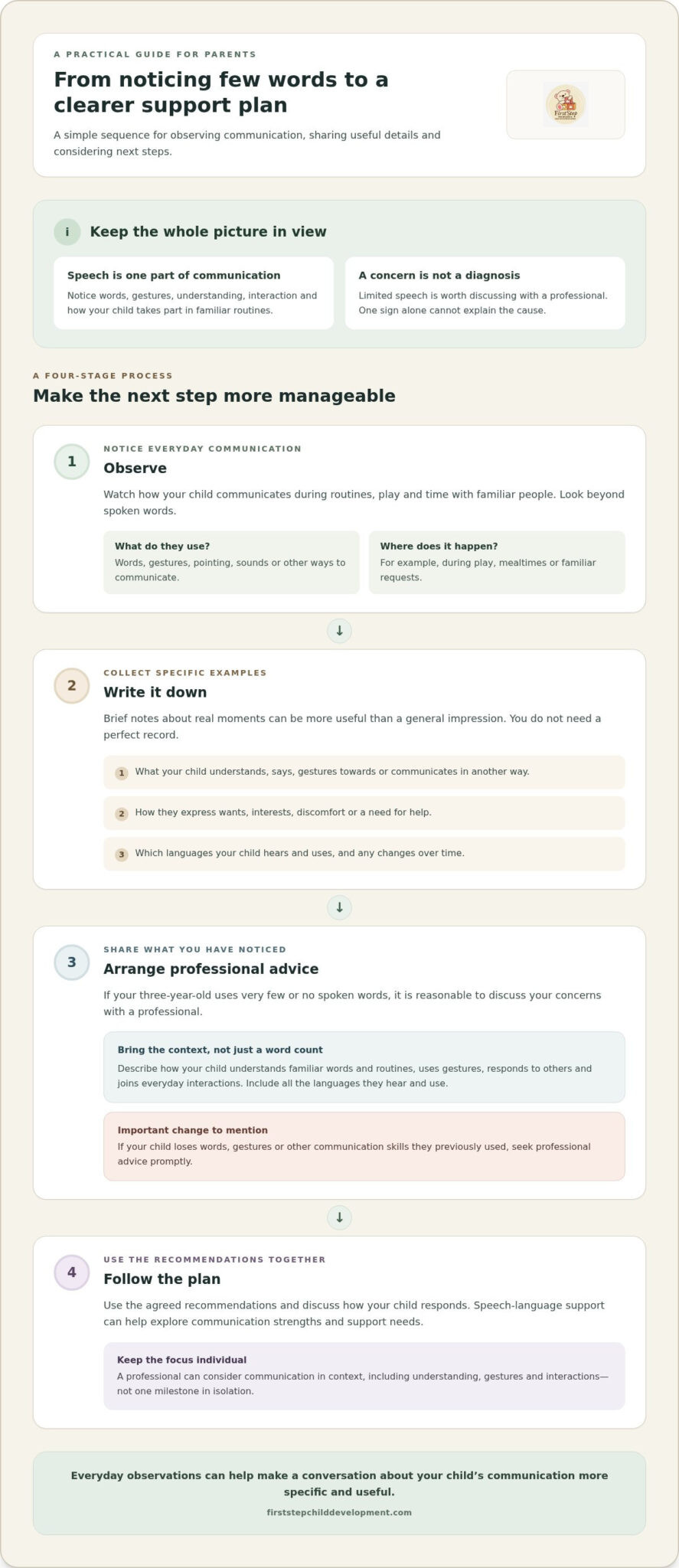
A simple plan can make the next step feel more manageable: observe your child, note specific examples, arrange professional advice, then follow the recommendations you agree on together. You don’t need to arrive with a perfect record. Everyday details can help a professional understand how your child communicates in real situations.
- Observe: Notice how your child communicates during routines, play and time with familiar people.
- Write it down: Record examples of what they understand, say, gesture towards or communicate in other ways.
- Arrange advice: Share your observations and raise any concerns about changes or participation.
- Follow the plan: Use the agreed recommendations and discuss how your child responds.
What to note before seeking advice
Keep brief notes about what happens, rather than relying on a general impression. For example, record whether your child follows a familiar request, points to share interest, or communicates a need during mealtimes. Include which languages your child hears and uses with family members and others. Growing up with more than one language doesn’t, by itself, explain a communication concern, so describe your child’s experience across all their languages. Note changes over time, too.
For wider context, you can read this guide to speech therapy support alongside professional advice.
Support communication while you seek guidance
Keep interaction warm and low-pressure. Follow your child’s interest in a toy, take turns during play, respond to gestures and sounds, and share books by talking about the pictures. Leave space for your child to respond without insisting they repeat words or treating conversation as a test. If you’re asking, “3 Year Old Not Talking: When Should Parents Worry?”, these everyday observations can also help make a professional discussion more specific.
When you’re ready, learn more about Firststep Psychology & Child Development Centre and the support available to families.
How speech therapy and child development support can help in Kuala Lumpur and Selangor
Speech therapy can help a child build communication skills in ways suited to their needs. Support may focus on understanding and expressing messages, using gestures, taking turns or communicating during everyday activities. The starting point is an individual understanding of how the child communicates, not an assumption that every child needs the same goals or approach.
What professional support may explore
A discussion may consider what your child already does well, what concerns you, and how communication affects participation at home or in other familiar settings. Your observations about play, routines and interactions can help provide context. A child developmental assessment may offer a broader view if questions extend beyond speech and language. Assessment and support are shaped around the child, with next steps discussed with parents.
At Firststep Psychology & Child Development Centre, speech therapy and child developmental assessment are available to families in Kuala Lumpur, Petaling Jaya and Selangor. The centre’s multidisciplinary team includes professionals such as clinical psychologists and paediatricians, which can be relevant when broader developmental questions arise. The aim is to understand a child’s strengths and support needs, not to promise a particular outcome.
Finding a supportive next step locally
If the question “3 Year Old Not Talking: When Should Parents Worry?” is on your mind, professional input can help make the concern clearer and identify suitable next steps. Parents can share what they have noticed and discuss whether speech therapy, a broader developmental assessment or another recommendation fits their child’s needs.
Explore Firststep’s speech therapy and learn about the assessment process to understand how professional support may begin. For an overview of the centre’s child development services, visit the Firststep homepage.
Take the next step at your own pace
It’s understandable to want certainty before seeking advice, but you don’t need to know the reason for a communication concern before asking for guidance. A conversation with a professional can help you make sense of what you’ve observed and consider an appropriate next step for your child.
If you’re still wondering, “3 Year Old Not Talking: When Should Parents Worry?”, let that concern be a reason to start a conversation, not a conclusion about your child. Support should recognise their individual strengths and needs, while giving you space to ask questions and understand the options.
When you feel ready, explore speech therapy support and learn more about Firststep Child Development. A thoughtful first step can bring greater clarity, and you don’t have to work everything out on your own.
Frequently Asked Questions
Can a 3-year-old who understands everything still have a speech delay?
Yes. Understanding familiar routines and expressing thoughts aloud are different skills, so a child may follow a well-known instruction yet struggle to ask for help or share an idea in words. Familiar context can also make understanding seem broader than it is. Tell a professional what your child manages comfortably as well as what feels difficult; apparent understanding alone doesn’t show whether support is needed.
Does speaking more than one language confuse a 3-year-old?
Exposure to more than one language shouldn’t be assumed to cause a communication difficulty. For a useful discussion, describe what your child understands and communicates in each language, including gestures, and who they usually communicate with. For instance, they may use one language with grandparents and another at preschool. If concerns persist across daily life, share this context with a qualified professional familiar with child development.
Can screen time cause a 3-year-old not to talk?
Screen exposure alone can’t establish why a child is speaking little. Communication opportunities also arise through responsive exchanges, such as noticing a child’s point, answering their sound or taking turns during play. A professional can consider the child’s wider circumstances rather than attributing speech to one factor. If you’re concerned, seek advice instead of relying only on changing screen routines to explain or resolve it.
What should I bring to a first appointment about my child’s speech?
Bring a few brief notes or examples: words your child uses, instructions they seem to understand, gestures they rely on and situations where communication is easier or harder. Include the languages used at home and when you first noticed your concern, along with any changes since then. These details help guide the conversation, but they don’t replace an individual professional assessment.
Will a speech concern at age three automatically mean my child has autism?
No. Limited speech by itself doesn’t establish autism or another diagnosis. Communication concerns can have different explanations, so a professional considers the child’s wider development rather than drawing conclusions from one sign. If you’re asking, “3 Year Old Not Talking: When Should Parents Worry?”, arrange an individual discussion if you remain concerned. A strength, such as responding to familiar words, doesn’t by itself rule out a need for support.
Article by
Firststep Child Development Team
Firststep Child Development Team provides evidence-informed educational resources to help parents better understand child development, behaviour and learning. Our multidisciplinary services include clinical psychology, occupational therapy, speech and language therapy, developmental assessments and other child development support in Kuala Lumpur and Selangor.
Disclaimer
This article is for general educational and informational purposes only and is not a substitute for professional medical, psychological or therapeutic advice, diagnosis or treatment. Every child develops differently. If you have concerns about your child's development, behaviour, learning or wellbeing, please consult an appropriately qualified healthcare or allied health professional.