


Autism Meltdown vs Tantrum:
What Every Parent Needs to Understand
When a child cries, screams, or throws themselves on the floor, many parents immediately think:
“This is just a tantrum.”
However, for children with Autism Spectrum Disorder (ASD), some of these behaviours may actually be meltdowns, which are very different from typical tantrums.
Understanding this difference is critical because the appropriate response for each is fundamentally different.
According to the DSM-5-TR, ASD is a neurodevelopmental disorder characterized by persistent deficits in social communication and social interaction across multiple contexts, alongside restricted, repetitive patterns of behavior, interests, or activities (American Psychiatric Association, 2022).
These neurological differences mean that individuals with ASD may process sensory information and emotional stressors differently than neurotypical children (Mpangane et al., 2024).
What is a Tantrum?
A tantrum is a goal-driven behaviour.
Children may have tantrums when they:
- Want something specific (toy, snack, attention)
- Struggle to communicate (they may not have the words to explain how they feel)
- Are tired or hungry (basic needs not met can trigger big reactions)
- Feel overwhelmed (too many emotions and they don’t know how to express them)

Key characteristics:
- The child is aware of their surroundings
- Behaviour typically stops once the child get what they want
- Often occurs in front of others (attention-seeking)
Tantrums are considered a normal part of early childhood development, reflecting a child’s increasing but still limited capacity to regulate impulses (Mata et al., 2025).
What is an Autism Meltdown?
A meltdown is not a choice. It happens when a child becomes overwhelmed and loses control.

Common triggers include:
- Sensory overload (loud noise, bright lights, crowds)
- Changes in routine
- Emotional overwhelm
Key characteristics:
- Not goal-driven
- Struggles to control the reaction
- May continue even without an audience
- Child may appear distressed, not defiant
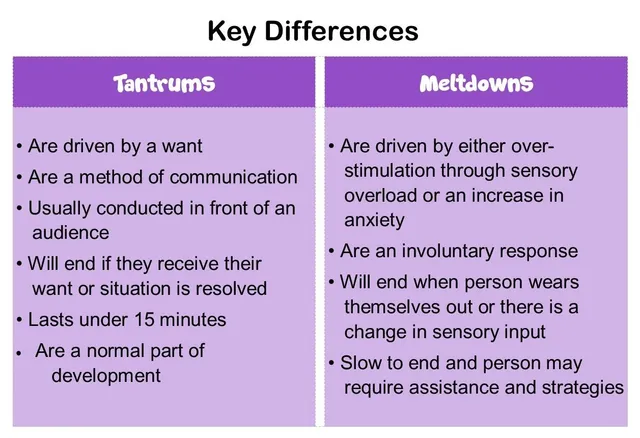
Key Differences Between Meltdown and Tantrum
1. Purpose
Tantrum: To get something
Meltdown: Reaction to overwhelm
2. Control
Tantrum: Child has some control
Meltdown: Child loses control and struggle to stop the reaction
3. Response to Rewards
Tantrum: Stops when child gets what they want
Meltdown: Continues regardless of rewards
4. Emotional State
Tantrum: Frustration or anger
Meltdown: Distress, anxiety, overload
Why This Difference Matters
Misunderstanding meltdowns can lead to:
- Punishing a child for something they cannot control
- Increased stress for both parent and child
- Escalation of behaviours
When we understand the underlying cause, we can respond more effectively, support the child’s emotional regulation, and create a safer, more supportive environment for their development
How Parents Can Respond
For Tantrums:
- Stay calm and consistent
- Set clear boundaries
- Avoid giving in to the specific demands that triggered the behavior
For Meltdowns:
- Reduce sensory input (quiet space, lower noise levels)
- Stay close and provide reassurance
- Avoid reasoning during the meltdown
- Allow time for the child to calm down

When Should Parents Seek Help?
Occasional tantrums are part of normal development. However, you may consider seeking professional advice if your child:
- Has frequent or intense meltdowns
- Struggles to calm down, even with appropriate and sufficient support
- Shows two-way communication difficulties
- Has limited social interaction
- Displays repetitive behaviours or sensory sensitivities
When these signs appear together and begin to affect a child’s daily functioning and social interactions, it may be helpful to learn more about the early signs of autism in toddlers and seek further evaluation from a professional.

A clinical psychologist can assist by evaluating developmental and behavioral assessments, identifying underlying challenges (e.g., autism, emotional regulation difficulties), and providing tailored intervention plans.
Early support ensures children receive the right help at the right time.
Early Support Can Make a Difference
With the right support, children can:
- Improve communication skills
- Develop coping strategies
- Learn strategies to manage their emotions
- Improve overall functioning in learning, daily activities, and social interactions
Early intervention is not about “fixing” a child; it’s about supporting their development in a way that works for them.
Not every emotional outburst is the same.
Understanding the difference between a tantrum and a meltdown helps parents respond with empathy, not frustration, especially when supporting children with Autism Spectrum Disorder.
With the right approach, parents can better support their child’s emotional regulation and overall development.
🌟 Stay Connected with Us! We love sharing tips, insights, and inspiring stories about children’s growth and mental wellbeing. 💙 Follow us on Instagram and Facebook for more updates and parenting advice.
Join our community and let’s grow together. One positive step at a time!

REFERENCES
American Psychiatric Association. (2022). Diagnostic and Statistical Manual of Mental Disorders (Fifth Edition, Text Revision). American Psychiatric
Association.
Mata, C., Pauen, S., Fumagalli, M., Giannì, M. L., Morniroli, D., Justyna Książek, Lotte Marijnissen, Southgate, V., Pluta, A., & Kampis, D. (2025).
Self- and Co-Regulation in European Caregiver-Child Dyads. European Psychologist, 30(1), 14–28.
https://doi.org/10.1027/1016-9040/a000543
Mpangane, E., Maepa, M. P., & Muhadisa, T. (2024). Challenges faced by newly appointed teachers at autism- specific school: A thematic analysis study.
The Open Public Health Journal, 17(1). https://doi.org/10.2174/0118749445322081241114104043
Working Hours
Tuesday to Saturday – 8.30am to 6pm
Monday & Sunday – Closed
Please also subscribe us at
Contact Us
Discover Our Team!
📞+60102502833
firststepdevelopmentcentre@gmail.com
B1-7, Plaza Damas 3, Jalan Sri Hartamas 1, 50480 Kuala Lumpur.
Copyright 2025. Firststep Child Development Sdn Bhd. All rights reserved.